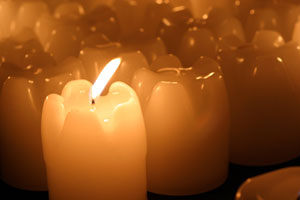
<?xml version="1.0" encoding="Shift_JIS"?>
<feed version="0.3" xmlns="http://purl.org/atom/ns#" xmlns:dc="http://purl.org/dc/elements/1.1/" xml:lang="en">
<title>100万人のキャンドルナイト2005　最新情報　英語版</title>
<link rel="alternate" type="text/html" href="http://www.candle-night.org/2005summer/mt-english/" />
<modified>2005-06-18T23:26:32Z</modified>
<tagline>100万人のキャンドルナイト2005　最新情報　英語版</tagline>
<id>tag:www.candle-night.org,2005:/2005summer/mt-english//13</id>
<generator url="http://www.movabletype.org/" version="3.01D-ja">Movable Type</generator>
<copyright>Copyright (c) 2005, candlenight</copyright>
<entry>
<title>Kaleidoscope is now open!</title>
<link rel="alternate" type="text/html" href="http://www.candle-night.org/2005summer/mt-english/archives/2005/06/kaleidoscope_is_1.html" />
<modified>2005-06-18T23:26:32Z</modified>
<issued>2005-06-18T13:01:43Z</issued>
<id>tag:www.candle-night.org,2005:/2005summer/mt-english//13.371</id>
<created>2005-06-18T13:01:43Z</created>
<summary type="text/plain">
&quot;Candle Kaleidoscope&quot; is an online mess...</summary>
<author>
<name>candlenight</name>

<email>satomi@miobox.jp</email>
</author>

<content type="text/html" mode="escaped" xml:lang="en" xml:base="http://www.candle-night.org/2005summer/mt-english/">
<![CDATA[<p><img alt="kaleidscope.jpg" src="http://www.candle-night.org/2005summer/mt-english/archives/kaleidscope.jpg" width="422" height="281" /><br />
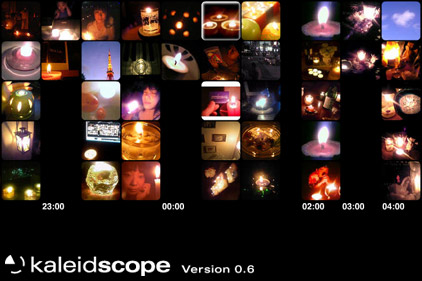
<strong>"Candle Kaleidoscope" </strong>is an online message board for pictures. Please visit at <br />
<a href="http://www.candle-night.org/2005summer/home.html">http://www.candle-night.org/2005summer/home.html</a> and click "Enter".  </p>

<p>Participants can send photographs of their Candle Night taken by mobile phone cameras or digital cameras via e&#8211;mail, and those photos will appear on the board. And when you put a cursor on a picture, the attached message will also appear. The boards will be a mandala-like photo gallery of various images of the Candle Night event.</p>

<p>Time: June 18, 20:00 through June 21, 22:00 (Japan Standard Time)<br />
e-mail address: photo@candle-n.org</p>

<p>Note: You can send the title (15 letters) <br />
and a message (45 letters) with the picture.<br />
</p>]]>

</content>
</entry>
<entry>
<title>Event Information</title>
<link rel="alternate" type="text/html" href="http://www.candle-night.org/2005summer/mt-english/archives/2005/06/event_informati.html" />
<modified>2005-06-18T01:13:27Z</modified>
<issued>2005-06-18T00:37:54Z</issued>
<id>tag:www.candle-night.org,2005:/2005summer/mt-english//13.367</id>
<created>2005-06-18T00:37:54Z</created>
<summary type="text/plain">*&quot;Count Down Event&quot; at the Tokyo Tower &amp;...</summary>
<author>
<name>candlenight</name>

<email>satomi@miobox.jp</email>
</author>

<content type="text/html" mode="escaped" xml:lang="en" xml:base="http://www.candle-night.org/2005summer/mt-english/">
<![CDATA[<p><strong>*"Count Down Event" at the Tokyo Tower & Zojoji Temple</strong><br />
Time: June 19 (SAT) from 16:00 to 22:00<br />
Place: Zojoji Temple, Minato-ku, Tokyo<br />
http://www.daichi.or.jp/pc/candlenight/happyakuyatou05.html</p>

<p><strong>*"Candle Night at Omotesando"</strong><br />
Time: June 19 (SAT) from 19:30 to 22:00<br />
Place: Omotesando, Shibuya-ku, Tokyo<br />
http://www.candle-night.org/2005summer/event/view.php?id=214</p>

<p><strong>*"GeshiFes 2005"</strong><br />
("geshi" means "summer solstice")<br />
Time: June 21 (TUE) from 18:00 to 20:30<br />
Place: Yoyogi Park, Shibuya-ku, Tokyo<br />
http://geshifes.cultivaders.com/event.html</p>

<p><strong>*"Candle Night Summer Solstice in EXPO 2005 Aichi"</strong><br />
Time: June 18 through 21, from 11:00 to 18:00: Candle Workshop&#8212;handmade beeswax candles<br />
         June 21(TUE) from 16:00-20:30: Talk show & Music Live<br />
Place: Earth Square, "NGO Global Village" in EXPO 2005 AICHI.<br />
</p>]]>

</content>
</entry>
<entry>
<title>A message from Australia</title>
<link rel="alternate" type="text/html" href="http://www.candle-night.org/2005summer/mt-english/archives/2005/06/a_message_from.html" />
<modified>2005-06-17T08:01:21Z</modified>
<issued>2005-06-17T07:51:55Z</issued>
<id>tag:www.candle-night.org,2005:/2005summer/mt-english//13.364</id>
<created>2005-06-17T07:51:55Z</created>
<summary type="text/plain">Greetings to Candle Nighters on the othe...</summary>
<author>
<name>candlenight</name>

<email>satomi@miobox.jp</email>
</author>

<content type="text/html" mode="escaped" xml:lang="en" xml:base="http://www.candle-night.org/2005summer/mt-english/">
<![CDATA[<p>Greetings to Candle Nighters on the other side of the world. </p>

<p>Here in Nimbin, Australia we had our first Candle Night party in June 2001. Once again this year our house will be bathed in the ethereal glow of candlelight as we enjoy good food and the company of friends. And as it is mid-winter here in the southern hemisphere, our fireplace will have a roaring fire to ward off the chill of the night.</p>

<p>And once again this year we will be adding a small practical step to the symbolism of our candle night celebration:- </p>

<p>Greenfleet, an Australian not for profit organisation, has a website that makes it very quick and easy for us to neutralise the effect of the carbon dioxide released by our modern lifestyles.</p>

<p>By planting forests of biodiversity in areas that have been damaged by deforestation and land degradation, Greenfleet can offset the CO2 emissions of people living anywhere in the world.</p>

<p>For $20 or less anyone can have their whole year's electricity use offset; alternatively they can sequester the CO2 from their car usage - even their air flights! </p>

<p>By planting trees Greenfleet is not only helping to slow global climate change, but at the same time contributing to the greening the planet. And amazingly your tree planting contributions will only add between 2 and 3% to the utility bills, fuel costs and airfares that make our modern life so comfortable and convenient.</p>

<p>Until renewable, non-polluting sources of energy, and technologies for greater energy efficiency become widely available I recommend this small step to everyone celebrating the Candle Night. Visit the Greenfleet website at: <br />
www.greenfleet.com.au</p>

<p>Wishing everyone an enjoyable Candle Night,</p>

<p>Nigel and Yoko</p>

<p>Nimbin, Australia</p>]]>

</content>
</entry>
<entry>
<title>Candlescape is now open!</title>
<link rel="alternate" type="text/html" href="http://www.candle-night.org/2005summer/mt-english/archives/2005/06/candlescape_is.html" />
<modified>2005-06-18T00:37:26Z</modified>
<issued>2005-06-17T04:40:28Z</issued>
<id>tag:www.candle-night.org,2005:/2005summer/mt-english//13.356</id>
<created>2005-06-17T04:40:28Z</created>
<summary type="text/plain">

http://www.candle-night.org/scape/

Pa...</summary>
<author>
<name>candlenight</name>

<email>satomi@miobox.jp</email>
</author>

<content type="text/html" mode="escaped" xml:lang="en" xml:base="http://www.candle-night.org/2005summer/mt-english/">
<![CDATA[<p><img alt="cs-message.gif" src="http://www.candle-night.org/2005summer/mt-english/archives/cs-message.gif" width="400" height="293" /></p>

<p>http://www.candle-night.org/scape/</p>

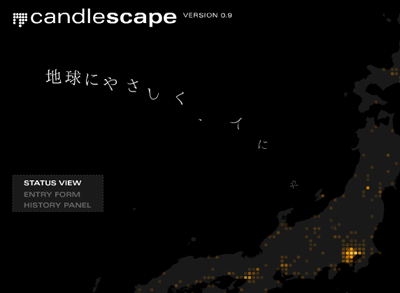
<p>Participants can send their messages to the Candlescape. With the use of postal codes, the system can identify the participant's location and can visualize it on the map of Japan with their message. Please visit the site, click "status view" and see how it works. Currently we have only Japanese map, but we would like to expand it worldwide in the near future.<br />
</p>]]>

</content>
</entry>
<entry>
<title>Candle Night in South Korea --Candle Night Newsletter #3</title>
<link rel="alternate" type="text/html" href="http://www.candle-night.org/2005summer/mt-english/archives/2005/06/candle_night_in.html" />
<modified>2005-06-17T08:06:50Z</modified>
<issued>2005-06-17T04:36:30Z</issued>
<id>tag:www.candle-night.org,2005:/2005summer/mt-english//13.355</id>
<created>2005-06-17T04:36:30Z</created>
<summary type="text/plain">Candle Night in South Korea

The prepara...</summary>
<author>
<name>candlenight</name>

<email>satomi@miobox.jp</email>
</author>

<content type="text/html" mode="escaped" xml:lang="en" xml:base="http://www.candle-night.org/2005summer/mt-english/">
<![CDATA[<p>Candle Night in South Korea</p>

<p>The preparation of the first "Candle Night" event in South Korea has been underway, mainly by college students in Seoul.</p>

<p>On the night of Summer Solstice, June 21, 2005, exterior lights of the youth culture center will be dimmed, and candles designed by art students will be exhibited. Various other plans such as music events and offering organic coffee samples are in preparation.</p>

<p>The students created a "community cafe", an online message board, asking others to join them. With the help and advice of other environmental NGOs and ex-journalists, they have tried to plan the first event in South Korea. The message board is found at: http://cafe.daum.net/candlenight</p>

<p>The students are planning to hold another Candle Night event in larger scale in October 2005. The Candle Night Newsletter will cover their initiative possibly in the future issues.</p>]]>

</content>
</entry>
<entry>
<title>Essay--Shinichi Tsuji--Candle Night Newsletter #3</title>
<link rel="alternate" type="text/html" href="http://www.candle-night.org/2005summer/mt-english/archives/2005/06/essayshinichi_t.html" />
<modified>2005-06-17T08:08:16Z</modified>
<issued>2005-06-17T04:33:19Z</issued>
<id>tag:www.candle-night.org,2005:/2005summer/mt-english//13.354</id>
<created>2005-06-17T04:33:19Z</created>
<summary type="text/plain">Essay
Shinichi Tsuji (Keibo Oiwa)
Candle...</summary>
<author>
<name>candlenight</name>

<email>satomi@miobox.jp</email>
</author>

<content type="text/html" mode="escaped" xml:lang="en" xml:base="http://www.candle-night.org/2005summer/mt-english/">
<![CDATA[<p>Essay<br />
Shinichi Tsuji (Keibo Oiwa)<br />
Candle Night Committee<br />
Cultural anthropologist, Professor at Meiji Gakuin University</p>

<p>Summer Solstice--it is the longest day of the year. Many traditional societies cerebrated, worshiped and prayed for it as a holy day. They were in awe and thankful--people at that time realized that they could only live thanks to the solar energy. However, no one today seems to remember those facts.</p>

<p>When you turn off the lights, darkness comes back. It has been a long time since the darkness disappeared from Japanese cities, where 80 percent of people live. Some people want to watch the moon and stars, or fireflies. Some might sit still in the darkness and some exchange their love for each other. Some make fire and others light candles. The flame of candles accentuates the darkness, and the darkness highlights the fire.</p>

<p>The majority of Japanese people eat dinner watching TV. Is this a sign of affluence? To me, this is simply a sign of cultural impoverishment. Let us turn out the lights and eat dinner under andlelight. Just a little act like that can give us a great opportunity: forming a circle, eating together and sitting by the firelight. Just think about it. Aren't these three major factors of culture to show what we, humankind, are all about?</p>

<p>I have had many opportunities to take my students to the ancient forests of North and South America. They looked happiest when they sat around a bonfire at night. Some even cried with a full smile on their faces. Then I realized--I took them all the way to see the moment. At the same time I was appalled by the fact that our "affluent" society could not give our children even that much joy. We seem to have pursued freedom under the fluorescent lamps. </p>

<p>We have been fixed in a strange idea that the more electricity we consume and the brighter the nights are, then society is more affluent and advanced, as the U.S. President Bush suggested 5 years ago that U.S. economy would be secured only if they construct one or two new power plants every week for the next 20 years. However, can we call it "economy" when its pursuit for money allows us to wage a war or to destroy the ecosystem that supports our lives? </p>

<p>Darkness, candlelight and bonfire will bring us a relaxing and peaceful time. Going with the flow of the time, we can come back to life from the madness of the "fast life" that has occupied us for a long time. Some might cynically say to us, "Such a little thing will not work for energy-saving," but we do not need to hold back. Candle Night can change me, and then the world, which I am part of, can certainly change, even though the change may be slight. </p>

<p>There is a folk legend that has been transmitted among indigenous peoples of South America.</p>

<p>"The forest was on fire. </p>

<p>All the animals, insects and birds in the forest rushed to escape. </p>

<p>But there was one little hummingbird named Kurikindi, or Golden Bird, <br />
who stayed behind. </p>

<p>This little bird went back and forth between water and fire, dropping a single <br />
drop of water from its beak onto the fire below.</p>

<p>When the animals saw this, they began to laugh at Kurikindi. <br />
"Why are you doing that?" they asked.</p>

<p>And Kurikindi replied, "I am only doing what I can do."</p>

<p>--I am as little as the hummingbird, but I will do just what I can do, too.<br />
</p>]]>

</content>
</entry>
<entry>
<title>Candle Night Newsletter #2 </title>
<link rel="alternate" type="text/html" href="http://www.candle-night.org/2005summer/mt-english/archives/2005/05/candle_night_ne_3.html" />
<modified>2005-05-17T13:31:32Z</modified>
<issued>2005-05-17T13:08:16Z</issued>
<id>tag:www.candle-night.org,2005:/2005summer/mt-english//13.224</id>
<created>2005-05-17T13:08:16Z</created>
<summary type="text/plain">The Candle Night Newsletter--#2
May 15, ...</summary>
<author>
<name>candlenight</name>

<email>satomi@miobox.jp</email>
</author>

<content type="text/html" mode="escaped" xml:lang="en" xml:base="http://www.candle-night.org/2005summer/mt-english/">
<![CDATA[<p>The Candle Night Newsletter--#2<br />
May 15, 2005, Copyright (c) 2005<br />
Candle Night Committee</p>

<p>The Candle Night is an event under the slogan of "Turn off lights and take it slow" on the night of summer solstice. This is a voluntary participatory event, initiated by Japan's environmental non government organizations, or NGOs.</p>

<p>The Candle Night Committee hopes to extend this event from Japan to the world, to the "Global Candle Night" event. We will provide readers with information and activities of the Candle Night.</p>

<p>-------------------Information-------------------<br />
The website of Candle Night has been updated to "Candle Night Summer Solstice 2005." This year's Candle Night will be enjoyed on the evenings of June 18 to 21, at 8:00 p.m. to 10:00 p. m. </p>

<p>The contents of the website are to be updated as the night of Summer Solstice approaches. Stay tuned at http://www.candle-night.org/<br />
----------------------------------------------------<br />
This issue features the following stories:<br />
Report--Candle Night at Harajuku Cat Street<br />
Essay--"Yobanashi" Tea Ceremony<br />
</p>]]>

</content>
</entry>
<entry>
<title>Essay--&quot;Yobanashi&quot; Tea Ceremony--Candle Night Newsletter #2</title>
<link rel="alternate" type="text/html" href="http://www.candle-night.org/2005summer/mt-english/archives/2005/05/candle_night_ne_2.html" />
<modified>2005-05-17T13:26:57Z</modified>
<issued>2005-05-17T13:04:05Z</issued>
<id>tag:www.candle-night.org,2005:/2005summer/mt-english//13.223</id>
<created>2005-05-17T13:04:05Z</created>
<summary type="text/plain">&quot;Yobanashi&quot; Tea Ceremony 
Madoka Mayuzum...</summary>
<author>
<name>candlenight</name>

<email>satomi@miobox.jp</email>
</author>

<content type="text/html" mode="escaped" xml:lang="en" xml:base="http://www.candle-night.org/2005summer/mt-english/">
<![CDATA[<p>"Yobanashi" Tea Ceremony <br />
Madoka Mayuzumi<br />
Haiku Poet</p>

<p>Japanese people love things that are in constant change. The shadow of fallen bamboo leaves reflecting on shoji (paper) screen. The look of dew on morning glories. Kuzufu, grass cloth, blowing in the wind and changing its shape. We are fascinated by the mutability of things that are transient, ephemeral and gone instantly.</p>

<p>In spring, tasting sake by the reflection of the cherry blossoms.<br />
In summer, pondering at the waterside.<br />
In autumn, traveling through the light of autumn leaves.<br />
In winter, reading letters by the reflection of snow.</p>

<p>The promise made under the dim light through a paper screen or dating in the moonlight remains as sweet memory in one's mind. The shadow, accompanied with the glimmering light, also flickers. The whole thing in the memory is mutable. Images and memories can be reshaped over time.</p>

<p>"yobanashi e shigururu zari no oto tatete"<br />
Yobanashi tea ceremony--<br />
in winter drizzle,<br />
sound of pebbles.</p>

<p>Last winter, I had an opportunity to attend a "Yobanashi" Tea Ceremony in Ohara, Kyoto, at the mountain villa of the long-established confectioner. The host of the tea ceremony was the owner of the villa. "Yobanash" Tea Ceremony is fully presented under candlelight. In the remaining red leaves of winter, guests were lead by handheld candles to the waiting place, walking on the wet pebbles and stepping stones. Whenever the candlelight flickers, wet moss on the stones glimmered. I felt as if I were deep in the water.</p>

<p>When we entered the waiting place, the host welcomed us with a flower and a haiku, as a head verse.</p>

<p>"chanohana ya makkurokuro ni shirosa kana"<br />
A flower--<br />
in darkness<br />
shines white.</p>

<p>After the main guest added the wakiku (second verse) closely followed the host's hokku (the head verse), the guest rang the bell and entered the tea room.</p>

<p>My verse was:<br />
"momijishigure no beni no naka nimo"<br />
In drizzle, maple leaves,<br />
reflects red.</p>

<p>As I was hurried by the other guests in the chilly evening, I had a hard time creating a verse to match the hokku. I used the contrast of colors, white tea flower, black night of darkness in Ohara, and red maple leaves in the winter rain.</p>

<p>The second verses of other guests were as follows:</p>

<p>"kokemederu kokoro o asobu chano shigusa"<br />
Cherish moss<br />
in mind,<br />
the motion of ceremony.</p>

<p>"gankou kiyoshi kangetsu no niwa"<br />
Geese fly in the night sky<br />
moonshine in the cold garden.</p>

<p>"oozora e kumono tanabiku sanzenin"<br />
In the sky,<br />
clouds drift<br />
over Sanzenin Temple.</p>

<p>"izure ro-ma no ano kuukan e"<br />
Through space to Rome<br />
at any point of time.</p>

<p>"ototatete tou o kizukishi yume o mimu"<br />
Dreams of building towers<br />
in sound.</p>

<p>"inishie yorino kaze o hakobite"<br />
Carry winds<br />
from ancient times.</p>

<p>"mirai e to iunano chawan yawarakaku"<br />
Tea cup named future<br />
soft and gentle.</p>

<p>kama naritakaku utsunemo kiyosi"<br />
Sounds of the tea pot,<br />
serene and pure.</p>

<p>The guests added their verses following the other's verse, while they were served tea. They focused colors first: white of a flower, black of darkness, red of maple leaves, green of moss, blue of sky. The verse jumped over space to Rome, and over time to ancient times. Then the teacup called "future" appeared. Following the ancient in the former verse, the host replied offering the teacup called "future". The guests were amazed with the host's witty reply. The whole process was going under the dim and sweet lighting of Japanese candles and flickering shadows. The only sounds were boiling water, serving tea and winter rain over the villa.</p>

<p>The decor and tea utensils by Kobori Enshu, the scroll of Shokado Shojo, a teacup of Rengetsuni, were all seen in the flickering lights and shadows reflected by the flame of candles. We talked and talked, and enjoyed the moment.</p>

<p>"Haikai poetry, the practice of composing linked sequences of waka poetry, is created by the poets' spontaneous ideas and the atmosphere the space provides. When wound up, an interesting play ends, too. I like the instant enjoyment as if I am watching a movie." It is a quote from Hiroshi Kojitani, one of the members of the ceremony.</p>

<p>The memory of the moment woven under the reflecting candlelight emerges more vividly as time goes by.<br />
</p>]]>

</content>
</entry>
<entry>
<title>Report--Candle Night at Harajuku Cat Street--Candle Night Newsletter #2</title>
<link rel="alternate" type="text/html" href="http://www.candle-night.org/2005summer/mt-english/archives/2005/05/candle_night_ne_1.html" />
<modified>2005-05-17T13:34:54Z</modified>
<issued>2005-05-17T12:56:14Z</issued>
<id>tag:www.candle-night.org,2005:/2005summer/mt-english//13.222</id>
<created>2005-05-17T12:56:14Z</created>
<summary type="text/plain">Candle Night at Harajuku Cat Street
Ayak...</summary>
<author>
<name>candlenight</name>

<email>satomi@miobox.jp</email>
</author>

<content type="text/html" mode="escaped" xml:lang="en" xml:base="http://www.candle-night.org/2005summer/mt-english/">
<![CDATA[<p>Candle Night at Harajuku Cat Street<br />
Ayako Shimizu<br />
Candle Night Committee</p>

<p>"Creator's Candle Design Exhibition," a new kind of event, was held at the "Candle Night　at Harajuku Cat Street" in Tokyo on December 21, 2004.</p>

<p>The “Candle Night at Harajuku Cat Street” has been held on the nights of Winter Solstice since 2002. Every year, design students decorate using candles under the theme of "Proposition to Reduce Excessive Lighting from Urban Nights." </p>

<p>In addition to the decoration, "Creator's Candle Design Exhibition" was held in 2004, in which creators in various fields such as graphic design and city planning, joined in and designed artistic candles for the exhibition.</p>

<p>The participants were Naoto Fukazawa, Ayumi Han, Taku Sato, Kazuko Fujie, Hidetoshi Ono, Kaoru Mende, Kazunari Hattori, Yasuhiro Suzuki, and Ryosuke Uehara & Yoshie Watanabe (D-BROS). Those foremost creators designed candles, seeking "a new candle design," which is a simple but challenging theme. Thus ten sets of unique art candles were created and showcased on the fifth floor of "Tree of Life "at Harajuku, a shop dealing with herbs, essential oils and so on. With the lights turned off, the candles were burning with dim flames in the dark exhibition site, displaying their design challenge.</p>

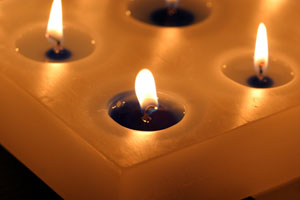
<p>Kaoru Mende, a lighting designer, created artwork named "Eroding Paraffin Lake," a flat white candle embedded with blue candles. As the candle burns, the blue and white wax melts <br />
creating a beautiful blue lake spreading across the white shore with an orange flame flickering on the lake. </p>

<p><img alt="mende.jpg" src="http://www.candle-night.org/2005summer/mt-english/archives/mende.jpg" width="300" height="200" /></p>

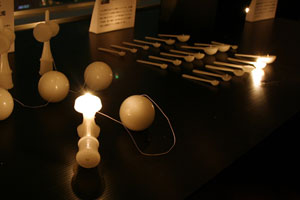
<p>Yasuhiro Suzuki, an artist, focused on the dissolving nature of candles and created three art candles: "Balance Scale," "Cup and Ball," a Japanese traditional wooden toy and "Spoon." The balance scale made of candle wax was displayed first unbalanced, then its irregularly set wicks were lit and started to melt and ended up balancing at a certain moment. The moment was so fantastic and the visitors who happened to see it balance were excited with the intellectual performance.</p>

<p><img alt="suzuki.jpg" src="http://www.candle-night.org/2005summer/mt-english/archives/suzuki.jpg" width="300" height="200" /></p>

<p>Taku Satoh, a graphic designer, made a candle in the shape of plastic bottle bottom, named "Rutobotoppe", a back slang of "Pettobotoru," which means a "Plastic bottle" in Japanese. The uniquely designed candle molded a plastic bottle upside down with a wick in the center of the bottom of the bottle. The artist who designed package for a plastic beverage bottle before, wanted people to notice how beautiful the bottles are and also humorously expressed the phrase "being lit on one's bottom" meaning to be pressured to meet the deadline, because this exhibition was held on winter solstice, around the end of year, the busiest time of year in Japan.</p>

<p><img alt="satou.jpg" src="http://www.candle-night.org/2005summer/mt-english/archives/satou.jpg" width="300" height="200" /></p>

<p>There were other candles that creators designed focusing on the shadows of flames, expressing how candle wax melts. Those exhibited ten sets of art candles, reflecting each creator's idea and style, entertained people who visited the exhibition.</p>

<p>Even though, those ten sets of candles were artistic expressions by the creators, they gave visitors encouragement to enjoy nighttime in the dim candle light. We hope to keep on holding new types of events like this one.</p>

<p>"The Creator's Candle Design Exhibition"<br />
Time: December 21, 2004<br />
Place: Tree of Life, Harajuku <br />
Participants: Naoto Fukazawa, Ayumi Han, Taku Sato, Kazuko Fujie, Hidetoshi Ono, Kaoru Mende, Kazunari Hattori, Yasuhiro Suzuki, and Ryosuke Uehara + Yoshie Watanabe (D-BROS), <br />
Co-Sponsored by Kameyma Candle</p>

<p><br />
</p>]]>

</content>
</entry>
<entry>
<title>Candle Night Newsletter #1</title>
<link rel="alternate" type="text/html" href="http://www.candle-night.org/2005summer/mt-english/archives/2004/12/candle_night_ne.html" />
<modified>2005-01-29T19:41:10Z</modified>
<issued>2004-12-10T13:56:15Z</issued>
<id>tag:www.candle-night.org,2004:/2005summer/mt-english//13.202</id>
<created>2004-12-10T13:56:15Z</created>
<summary type="text/plain">The Candle Night Newsletter--#1
December...</summary>
<author>
<name>candlenight</name>

<email>satomi@miobox.jp</email>
</author>

<content type="text/html" mode="escaped" xml:lang="en" xml:base="http://www.candle-night.org/2005summer/mt-english/">
<![CDATA[<p>The Candle Night Newsletter--#1<br />
December 10, Copyright (c) 2004<br />
Candle Night Committee</p>

<p>The Candle Night is an event under the slogan of "Turn off lights <br />
and take it slow" on the night of summer solstice. This is a <br />
voluntary participatory event, initiated by Japan's environmental <br />
non government organizations, or NGOs.<br />
<a href="http://www.candle-night.org/">http://www.candle-night.org/</a></p>

<p>The Candle Night Committee hopes to extend this event from Japan <br />
to the world, to the "Global Candle Night" event. We will provide <br />
readers with information and activities of the Candle Night.</p>

<p>This issue features the following stories:<br />
-The report on the "Candle Night"-Summer Solstice 2004 in <br />
Japan<br />
-A Vow to "Diet of Light"<br />
-Japanese stories on "candles" and invitation to the readers</p>

<p>----------------------------------------------------<br />
</p>]]>
<![CDATA[<p>'Candle Night'-Summer Solstice 2004 in Japan </p>

<p>Shinichi Takemura<br />
Candle Night Committee<br />
Anthropologist, Professor at Kyoto University of Art & Design</p>

<p>The trend in which people seek a new sense of values and <br />
lifestyles beyond the civilization of mass production <br />
and mass consumption in the 20th century have been gaining <br />
momentum among Japanese citizens. One example that <br />
symbolizes this trend is the Candle Night event. <br />
<a href="http://www.candle-night.org/">http://www.candle-night.org/</a></p>

<p>Under the slogan of "Turn off your lights, and take it slow," <br />
for two hours on the summer solstice, the Candle Night event <br />
started on June 22, 2003. This voluntary participatory <br />
event was originally initiated by several Japan's <br />
environmental non governmental organizations, or NGOs.</p>

<p>Responding to calls from the Candle Night committee, various <br />
groups such as the Ministry of the Environment (MOE), <br />
businesses, municipal governments and public facilities as well <br />
as artists in a variety of fields across Japan showed support for <br />
the event. Thus, the movement gained momentum and its popularity <br />
among the citizens swelled. According to an estimate by the MOE, <br />
a total of 5 million people nationwide participated in the event in <br />
2003. Over 200 major landmark facilities, such as the Tokyo <br />
Tower, Rainbow Bridge and Himeji Castle, turned their lights off. <br />
The Candle Night became one of the major summer events.</p>

<p>NEC Corporation, one of the major manufactures of electrical <br />
machinery in Japan, participated in the event on a company-wide <br />
basis, with about ten million employees and their family members. <br />
Iwate prefectural government also joined the event with all <br />
of its prefectural citizens. In this way, large numbers of businesses <br />
and local governments expressed their support for the events. It is <br />
a clear example showing cooperation and collaboration among the <br />
public sector, private businesses and citizens. This has become a <br />
major trend and is now more common in Japan.</p>

<p>In this year's "Candle Night-Summer Solstice 2004" event, more <br />
than 5,000 major facilities turned off their lights and convenience <br />
stores across Japan voluntarily turned off their signs. During the <br />
three day (Saturday-Monday) 2004 Candle Night, an estimated 6.5 <br />
million peopled joined the event.</p>

<p>Last year, many unique local candle events were also held across <br />
the country. During their Candle Night event, some towns <br />
established their own traditional "light"-scape, while others <br />
decided to do a Candle Night every weekend to add to local charm.</p>

<p>Our Candle Night does not place any specific rules on participants. <br />
It only encourages them to turn off the lights voluntarily and to <br />
enjoy something different and unusual for two hours. The idea of <br />
our initiative originated from the Voluntary Blackout movement <br />
that started in the United States, but our approach is not limited <br />
to energy saving nor power saving.</p>

<p>In fact, many people joined the Candle Night with strong hopes for <br />
peace and a clean global environment. However this event is <br />
symbolic. Rather than striving to attain a specific goal such as <br />
reducing carbon dioxide emissions, it simply gives people an <br />
opportunity to review and rethink their lifestyles and themselves <br />
during these two hours.</p>

<p>The style of participating in this event, therefore, varies from <br />
person to person. Some people focus on strengthening and <br />
reconfirming their family bond by taking extra time to enjoy dinner <br />
slowly, or taking a bath together. Others go to events such as the <br />
Candle Concert, or find themselves re-appreciating the beauty of <br />
stars alone in the darkness of downtown. On our website, a truck <br />
driver announced his intention to turn off his engines while <br />
parked.</p>

<p>The Candle Night event does not focus on attaining any specific <br />
goals collectively. Rather, it tries to offer participants an <br />
opportunity to discover a new sense of values, or offer an <br />
alternative lifestyle for their future. The Candle Night Committee <br />
hopes that the event can provide participants with a platform <br />
where people can join it at their own will and way.</p>

<p>Sharing the concept without having any specific "rules" may be one <br />
example of the Japanese way of thinking. We are sure that by <br />
expanding the scope of potential participants, the event has gained <br />
the popularity from people of all ranks, beyond regional borders <br />
and generations. Another typically Japanese element is the use of <br />
cell phones for joining and enjoying this event. This integrates the <br />
cutting-edge IT based community with the slower-paced <br />
environmentally aware movement.</p>

<p>The committee invited participants to send messages via the <br />
internet several weeks before the event. The "Candlescape" <br />
platform can monitor how the participants across Japan have <br />
increased on a real-time basis. Participants visited the <br />
Candlescape website <br />
(<a href="http://www.candle-night.org/2004/jp/apply/index.html">http://www.candle-night.org/2004/jp/apply/index.html</a>), and sent <br />
their messages and their postal code. With the use of postal codes, <br />
the system can identify the participant's location and can visualize <br />
it on the map of Japan.</p>

<p>Through this map-typed message board, the participants can <br />
realize the link with other numerous participants scattered all <br />
over Japan. They can share a sense of unity with an invisible <br />
community, a so-called a virtual community, where people are <br />
linked to each other by a new sense of value.</p>

<p>This network-based participation was enhanced by another <br />
web-based program, the "Candle Kaleidoscope," also available on <br />
our website. "Candle Kaleidoscope" was a real-time online message <br />
board for pictures. Participants sent photographs of their Candle <br />
Night taken by mobile phone cameras via e -mail, and those photos <br />
appeared on the board on a real time basis. The boards became a <br />
mandala-like photo gallery of various images of the Candle Night <br />
event. Please visit our website <br />
<a href="http://www.candle-night.org/2004/index.html">http://www.candle-night.org/2004/index.html</a>, click <br />
"Kaleidoscope," and you can find the 2004 Kaleidoscope.</p>

<p>Some participants sent pictures of family and friends with a Haiku. <br />
Haiku is a form of traditional Japanese poetry, a 17-syllable verse <br />
form consisting of three metrical units of 5, 7, and 5 syllables. The <br />
art of Haiku or traditional space of light and shadow generated by <br />
candle light were revitalized through electrical network.</p>

<p>The next event is the "Candle Night"-Winter Solicits 2004. This is <br />
not a large-scaled event like in the summer, but grass-root, <br />
voluntary movement for the winter event has already started in <br />
many places. In our next news letter, we will report the result of <br />
the winter event.</p>

<p>----------------------------------------------------<br />
Slow Life-A Vow to "Diet of Light"</p>

<p>Kaoru Mende<br />
Lighting designer, leader of the Transnational Lighting Detectives, <br />
Professor at Musashino Art University</p>

<p>I am a lighting designer and have been working in the field of <br />
urban environmental and architecture lighting. My job is to <br />
propose designs for indoor or outdoor lighting to meet the clients' <br />
expectations. Against the current trend in lighting design i.e. <br />
adding up excessive light, I often focus on "shadow design" as a way <br />
of lighting. That means that beautiful shadows or striking <br />
darkness can be generated by reducing unnecessary light and using <br />
minimum lighting only in necessary places. As a matter of fact, <br />
lighting design is synonymous with shadow design. I believe an <br />
important theme in lighting design is the careful use of shadows <br />
and darkness. It's not just about filling a space with light. </p>

<p>We are all suffering from "bulimia of light." In fact, there are many <br />
people who have never been moved to tears by watching the sky full <br />
of stars, or those who have stepped on shadows under the bright <br />
moon light. They have been forced to live watching bright TV and <br />
computer screens since they were born. Some children are not able <br />
to sleep in the darkness. This is especially true for Japanese <br />
people, who like to use extremely bright fluorescent lamps even for <br />
residential use. Due to limited sources of illumination in the past, <br />
the Japanese have come to associate bright lights with wealth and <br />
abundance. They have come to have an unusual sense of brightness. <br />
The Japanese are not proud of their insensitivity to light. The <br />
reason behind this insensitivity is that Japanese people have never <br />
experienced an eye-friendly, comfortably lit environment. The <br />
Japanese have worked hard to light brightly and evenly but now <br />
realize that it's the quality of the light matters, not the quantity.</p>

<p>Excessively high luminance levels at convenience stores and drug <br />
stores create a living environment where day and night are <br />
reversed. Nobody would be troubled, nor would anything happen if <br />
all the convenience stores across Japan turned off the ceiling <br />
lights by half and lowered the light level to 500 to 700 lux at night. <br />
Customers may be stunned at first, but they would get used to it <br />
comfortably in a week or so. Another change could be made to <br />
vending machines, which are lit up all day. The lights could be <br />
turned off during daylight hours, probably without any notice or <br />
reaction.</p>

<p>To reduce the excessive lighting, what we call "Diet of Light," is <br />
one of the central issues in the 21st century. How can we abandon <br />
the vested interest of using abundant lighting we have created <br />
since the last century, and how can we get away from "light <br />
bulimia?" Lighting habits can be compared to eating habits. This <br />
means that using a small amount of light wisely could be compared <br />
to enjoying a small amount of healthy food. Japanese people have <br />
been enjoying one of the healthiest and the most traditional diets <br />
in the world. Why can't we also enjoy "healthy" amount of lights, <br />
similar to the healthy traditional low-calorie, low-fat <br />
vegetarian-like diet? Should we go to a fasting center to do that? <br />
One of the important goals in living a so-called "slow life," a <br />
relaxed, simplified life, is how to use lighting effectively. We need <br />
to experience the utter darkness and its beauty to find a better way <br />
of using minimum lighting in the so-called "slow life". We need to <br />
reduce the volume of light in life. We need to start by enjoying the <br />
darkness and the night. It is important for us to turn off lights and <br />
get back to darkness because real darkness can make people realize <br />
their fears. It can also make people reflect on their inner self, give <br />
them time to think of their loved ones and of their past. <br />
Furthermore, when in complete darkness people can then <br />
appreciate and be fascinated by even small amounts of light. The <br />
Candle Night movement offers us an opportunity to share the value <br />
of a "Diet of Light" with people all over the world. The experience <br />
of darkness, even for a brief moment, is important. </p>

<p>Notes from the Candlelight Committee: In the Candle <br />
Night-Summer Solstice 2004 event, Japan's major convenience <br />
stores such as Seven-Eleven and Lawson cooperated to turn off <br />
their signs altogether. On Omotesando Street in Harajuku, Tokyo, <br />
one of the trendiest fashion streets in Japan, fancy boutiques such <br />
as Channel and other stores turned off the lights during the Candle <br />
Night event. This means that people's sense of value seems to be <br />
changing.</p>

<p>Kaoru Mende is one of the leading figures of the event in <br />
Omotesando.</p>

<p>--------------------------------------------------<br />
In Japan, there remain many folk tales, stories and local practices <br />
associated with candles. Today, we introduce you to one of those <br />
stories, "The Red Candles and the Mermaid," written by Mimei <br />
Ogawa.</p>

<p>Once, there lived a mermaid in the northern sea .in Japan. The <br />
mermaid, wishing for her daughters happiness, decided to let her <br />
new-born live in human society. The daughter was brought up by an <br />
old couple who made and sold candles. She grew up to be a gentle <br />
girl. She started drawing beautiful pictures on the candles to repay <br />
the old couple for their favor. The candles became very popular as <br />
the rumor spread that if they were offered on the shrine, ships <br />
wouldn't be wrecked. Despite growing very rich, the couple was <br />
enticed by a merchant into selling the girl. The merchant had heard <br />
about the mermaid, wanted her for his freak show. The girl didn't <br />
stop drawing pictures on the candles until the last minute. When <br />
she left the house, she colored some candles all in red. On the night <br />
she was sold, a woman came to the candle shop and bought the red <br />
candle. That night, a big storm broke and the boat the mermaid girl <br />
was onboard sunk. Since then, the superstition has persisted that <br />
if red candles were lit at the mountain shrine, a big storm would <br />
come and the person who saw the flame of the candle light would die <br />
in the ocean. The town was ruined in the end.</p>

<p>Interestingly, other candle-related practices are still observed in <br />
Hokkaido, a northern island of Japan.</p>

<p>On August 7th, the night of Tanabata, the Star Festival according <br />
to lunar calendar, groups of children walk around neighborhoods <br />
knocking at each door singing "Ro-so-ku da-se-yo" meaning "give us <br />
candles," or we will scratch you. (The phrases vary from region to <br />
region.) Then residents give them some sweets. This practice <br />
originated from an old tradition of visiting neighbors to ask for <br />
candles during Obon, the period that ancestor's souls are said to <br />
come home. Recently most residents serve children sweets instead <br />
of candles. This is similar to "Trick or Treat" in the Halloween of <br />
Western countries, isn't it? Although there are only a few towns in <br />
Hokkaido who still observe this annual event, children in those <br />
areas look forward to the local event and enjoy it every year.</p>

<p>Are there any "candle stories" in your country? If you have unique <br />
stories, practices or festivals associated with candles or light and <br />
shadows in your country, please let us know. We would like to <br />
introduce them to our world readers, too.</p>

<p>If you find the Candle Night Newsletter interesting and want to <br />
continue to receive our newsletters, please e-mail us at <br />
eninfo@candle-night.org to confirm your subscription.</p>

<p>Please forward the newsletter to friends and suggest that they <br />
start their own free subscriptions. We want to extend this <br />
movement to the world.</p>

<p>We are looking forward to your feedbacks from this newsletter. </p>

<p>We hope you enjoyed this issue of the Candle Night Newsletter. We <br />
will be back next issue with more information and stories.</p>

<p>-------------------------------------------------------------<br />
This newsletter is to be sent only to those who have registered for <br />
it. We do not rent, loan or sell this e-mailing list to any other party. <br />
If you wish to subscribe, please e-mail us at <br />
eninfo@candle-night.org.</p>

<p>We welcome your comments. Please send them to: <br />
eninfo@candle-night.org. </p>

<p>Copyright (c) 2004, Candle Night Committee. <br />
All Rights Reserved.</p>

<p>Candle Night Committee<br />
eninfo@candle-night.org</p>]]>
</content>
</entry>
<entry>
<title>Candle Night&amp;#8212;Summer Solstice 2005</title>
<link rel="alternate" type="text/html" href="http://www.candle-night.org/2005summer/mt-english/archives/2004/09/candle_nightsum.html" />
<modified>2005-01-29T19:26:47Z</modified>
<issued>2004-09-19T16:53:05Z</issued>
<id>tag:www.candle-night.org,2004:/2005summer/mt-english//13.200</id>
<created>2004-09-19T16:53:05Z</created>
<summary type="text/plain">The Candle Night 2005 will be carried ou...</summary>
<author>
<name>candlenight</name>

<email>satomi@miobox.jp</email>
</author>

<content type="text/html" mode="escaped" xml:lang="en" xml:base="http://www.candle-night.org/2005summer/mt-english/">
<![CDATA[<p>The Candle Night 2005 will be carried out on the night of the summer solstice 2005.</p>

<p>The Candle Night Committee has started to prepare for next year's event. The progress of   preparations is to be reported on this weblog.<br />
	<br />
Turn out your lights on the night, and enjoy the darkness together.</p>]]>

</content>
</entry>

</feed>